
How Can Companies Increase Their Chances of Success When Investing in Another Country?

Before making any move, companies need to plan based on reliable information tailored to their specific business needs.

Many executives plan to expand internationally without a specific country in mind. In these cases, competitive and market intelligence teams often conduct an initial assessment covering the countries under consideration to identify those with the strongest potential and best prospects.

In the second stage, the countries selected in the initial study undergo more in-depth analysis.

Below are three critical areas that should be included in any assessment before a company decides to enter a new market.

WHAT DO YOU NEED TO KNOW?
Understand local regulations

WHY DO YOU NEED TO KNOW IT?
Local regulations can impact manufacturing and trade in many ways. This includes tariffs, taxes, regulatory requirements, manufacturing standards, and mandatory product specifications.

WHAT DO YOU NEED TO KNOW?
Identify multinational and local competitors

WHY DO YOU NEED TO KNOW IT?
Analyzing competitive forces helps define the best strategy for introducing a new product into the market. A competitive and market intelligence study provides comparisons of prices, product features, and competitors’ market share. Competitor analysis also helps identify key factors related to the production, distribution, and sale of similar products.

WHAT DO YOU NEED TO KNOW?
Understand consumer behavior

WHY DO YOU NEED TO KNOW IT?
To position a product effectively, companies must understand consumer needs, purchasing behavior, perceived value, and customer opinions about competing products. A competitive and market intelligence study generates valuable insights as input for marketing strategies and helps create tailored sales arguments for the new product.

The Limitations of Big Data
Related Posts

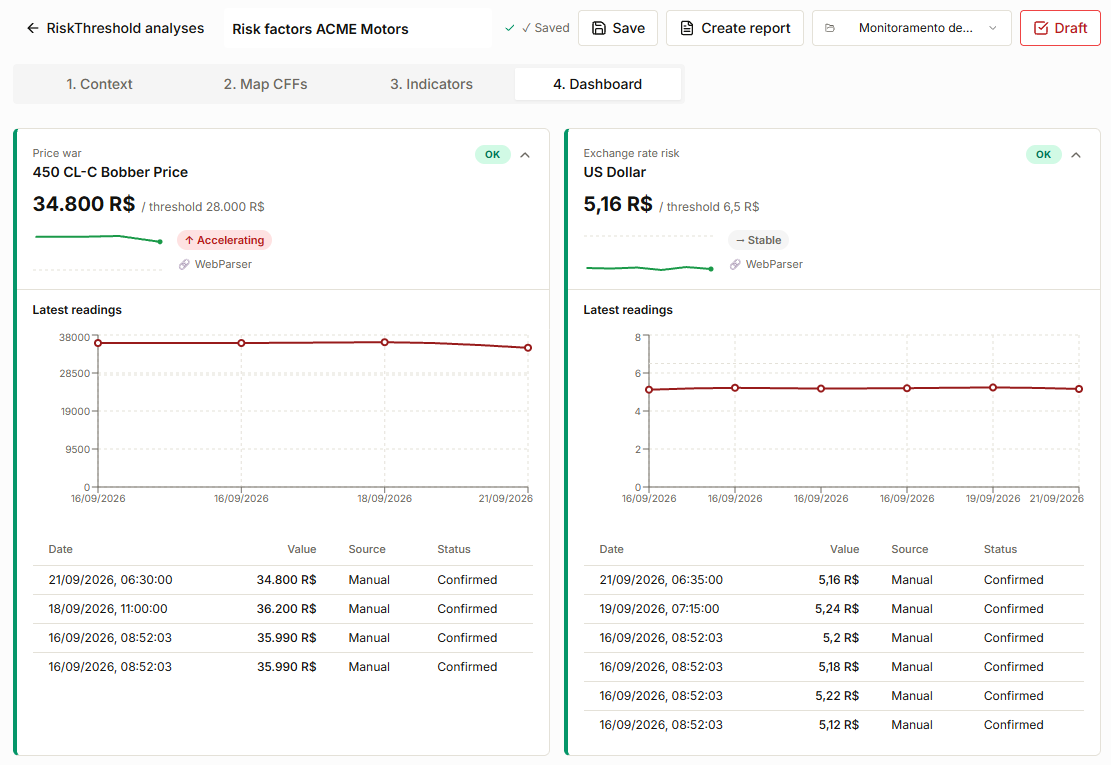
Screenshot showing the use of RiskThreshold. The example displays the monitoring dashboard with ACME Motors’ risk and threat factors. The listed risk factors are foreign exchange risk, with the dollar as the indicator; economic crisis, with monthly IPCA inflation and monthly INPC inflation as indicators; dissatisfaction with the brand or products, with the Reclame Aqui complaint index as the indicator; and price war, with four competitors being monitored. For each factor, the current status or value is shown alongside the defined threshold value. Each factor also displays the monitoring result, indicating whether the risk factor is stable or accelerating and which factors require attention.

30

Sep
All Subjects, Analysis, Market and Competitive Intelligence

New Tool Monitors Risks and Threats to Your Business

Did you know that Link Estratégia has its own methodology for monitoring risks and threats to your business? It is called RiskThreshold and is one of the monitoring modules available on Hub Link Estratégia, our market and competitive intelligence platform. Using RiskThreshold, decision-makers can monitor what we call Critical Failure Factors (CFFs) for the business.

31

Aug
All Subjects, Market and Competitive Intelligence

How to Assess Brand Perception in the B2B Market

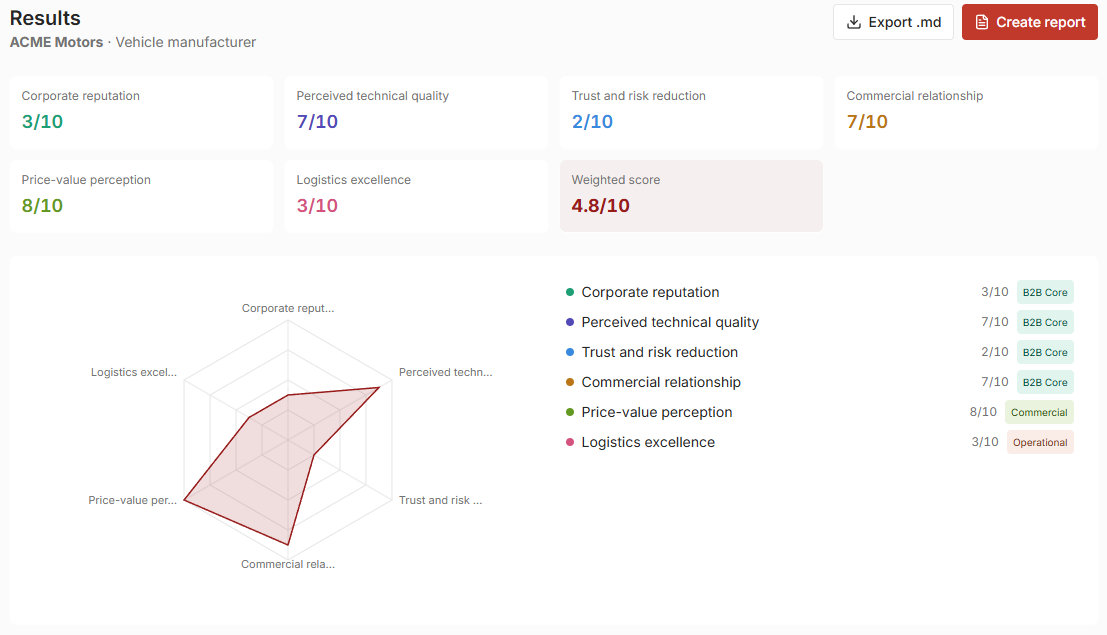
Brand perception in B2B markets does not serve to create superficial emotional appeal, but rather to fulfill a much more pragmatic role: reduce perceived risk in purchasing decisions, sustain long-term commercial relationships, and differentiate the value proposition where price and delivery truly matter.
To structure this diagnosis with methodological rigor, we developed BrandIntel, the brand equity assessment module of Hub Link Estratégia. This module also can be used to assess B2C and B2B2C brands.